


Hexane: Solvent Debate for Oil Mills
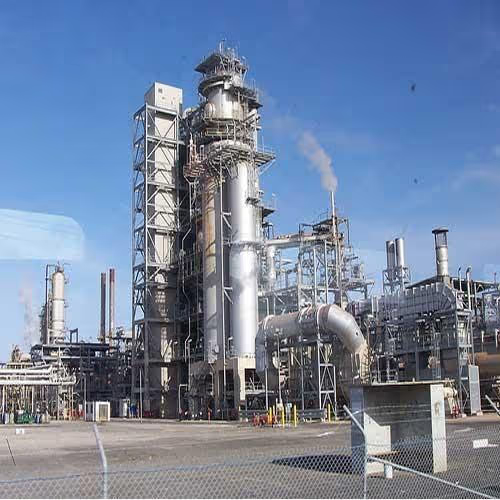
Here is something most people never think about: much of the refined sunflower and rapeseed oil on supermarket shelves contains oil that was washed out of the seed with a petroleum-derived solvent. The seeds are first pressed, which squeezes out most of the oil. What remains, the press cake, still holds typically 7 to 20% oil. [1] So the cake is soaked in hexane, a solvent, which dissolves the remaining fat. The hexane is evaporated and reused, the oil goes back to the refinery to be reused, and the defatted cake, called meal, becomes protein-rich animal feed. [2]
Hexane has done this job for decades, and it does it very well. That is exactly what makes the current debate so interesting. This article sums up the alternatives. And why, in our view, the most interesting opportunity is not in the extractor at all.
Why Everyone Is Suddenly Talking About Hexane
The EU safety assessment of hexane as a food extraction solvent is about 30 years old. In 2024, the European Food Safety Authority (EFSA) concluded that it needs to be redone. [3] The European Commission made it official in May 2025, and EFSA has until November 2027 to deliver its new opinion. [4] [5]
Two things triggered this. The first is exposure. The old assessment assumed an intake of about 0.1 mg hexane per kg body weight per day, while EFSA's 2024 worst-case estimate for infants, calculated with deliberately conservative assumptions, reached up to 7.8 mg. [4] The second is identity. "Technical hexane" is not one pure substance but a petroleum fraction, typically around half n-hexane plus related molecules, and what else it contains has never been precisely specified. [4] [6]
Workers already feel the pressure. n-Hexane is classified as suspected of damaging fertility and was recently moved to the highest hazard category for nerve damage from repeated exposure. France allows only 20 ppm in workplace air, stricter than for any other solvent in the comparison. [6]
For food, the EU currently allows at most 1 mg of hexane residue per kg of oil. [7] Nobody knows yet what EFSA will conclude. But here is a detail worth knowing: if that limit were cut sharply, labs would struggle to even prove compliance, because routine methods can reliably quantify hexane in oil only down to about 0.1 mg/kg. [6]
Why Hexane Is So Hard to Replace
The review series is refreshingly blunt: technically, hexane is still the best solvent for oil mills. [6] It dissolves oil eagerly, it does not mix with water, so separating and recycling it is easy, and it takes little energy to boil off. Entire plants, down to the size of every heat exchanger and the rubber of every seal, are built around its properties. [2]
Going solvent-free is not the answer either. Pressing only would mean less oil, a higher fire risk from oily cake in storage, and meals that are harder to use in compound feed and would partly be replaced by imports. [6] Solvent extraction of press cake is here to stay. The real question is: with which solvent?
Candidate 1: Ethanol, the Crowd Favourite
Ethanol is the alcohol in wine and beer, and that is part of its appeal: nobody is scared of it. It needs no specific residue limit in the EU, it switches off seed enzymes that would otherwise break down the oil, and when the oil is recovered by cooling it tends to be less acidic and richer in tocopherols, the natural vitamin E of the seed. [8] [6] It is also kinder to workers than hexane. [9]
The catch is physics. Ethanol loves water and is not particularly fond of oil. So the seeds must be dried first, water must be continuously removed from the recycled solvent (for example by pervaporation, a membrane process that pulls water out), and the oil is best recovered not by boiling off the solvent but by chilling the solvent and oil mixture, called the miscella, until the oil separates. [2] Even then, roughly 76% more heat than with hexane, and the desolventizer, the large steam-heated vessel that drives the solvent out of the meal, needs more than twice the heat. [10] [6] More heat for longer also means more risk of damaging the protein in the meal, a key revenue stream for any crusher. [11]
Candidate 2: 2-MeOx, the Look-Alike
2-Methyloxolane, or 2-MeOx for short (chemists also call it 2-methyltetrahydrofuran), is a bio-based solvent that behaves remarkably like hexane when it comes to dissolving oil. [13] The EU added it to the list of approved extraction solvents in January 2023, with the same 1 mg/kg residue limit as hexane. [14] [6] It is the only alternative currently going through a full industrial qualification. [6]
The first semi-industrial results are impressive. In a continuous pilot extractor with soybean flakes, 2-MeOx left only a quarter as much oil in the meal as hexane (0.48 versus 1.94 g per 100 g). The oil contained more than 20 times as many phenolic compounds, the seed's natural antioxidants, and resisted oxidation for more than 70 hours in an accelerated test, compared with 17.8 hours for the hexane oil. [14]
Now the fine print. The same 2-MeOx oil had almost five times the peroxide value, a standard measure of early oxidation (12.53 versus 2.65 meq/kg). The likely culprit is the solvent itself, which tends to form peroxides. More antioxidants and more peroxides in the same bottle: welcome to lipid chemistry. The meal also held on to more solvent, which means more work for the desolventizer. [14] [8] Overall heat demand is estimated at about 35% above hexane. [10] One crutial problem is, that 2-MeOx is incompatible with the standard rubber seals of hexane plants, so gaskets would have to be replaced with expensive perfluorinated ones, and pharmaceutical solvent selection guides rate it as problematic. [6]
So Who Wins?
Nobody, and that is the honest conclusion. Hexane is still the most efficient. Ethanol and isopropanol win on worker safety, ethyl acetate on energy, ethanol and ethyl acetate on food safety, and 2-MeOx may become a credible industrial option once its qualification data are completed and published. [6] Every switch means rebuilding parts of the plant, from desolventizers and heat exchangers to boilers and seals, and usually a higher energy bill. [2] [10] [6]
The Plot Twist: Polyphenols
Look closely at how 2-MeOx is being positioned. The patent starts from the observation that hexane cannot deliver a polyphenol-rich oil, and the industrial trials highlight phenolics and oxidative stability as key benefits. [15] [14] In other words, the solvent industry has discovered what lipid scientists have been saying for years: the minor compounds of the seed, such as polyphenols, carry much of an oil's value.
There is just one problem. In a conventional mill, crude oil goes to the refinery, and refining strips out most of those phenolic compounds along with solvent traces, colour and off-flavours. [6] Refining means degumming, neutralization, bleaching and finally deodorization, a high-temperature steam treatment that removes odours. It is what makes extracted oil safe and neutral. It is also where the natural antioxidants disappear, and where antioxidants are often added back afterwards. So no matter which solvent pulls more polyphenols into the crude oil, most of them are gone by the time the oil is bottled.
Where Lipid Legends Comes In
Our technology works upstream of the solvent, on the pressed oil, so it fits any extraction line: hexane, 2-MeOx, ethanol or whatever comes next.
In most mills, press oil and extracted oil are refined together. With Lipid Legends technology, the press oil is optimized into a native oil that needs neither refining nor added antioxidants. Only the extracted oil still goes to the refinery.
And this is not just another cold-pressed oil. Ordinary cold-pressed oils are delicate under heat. Ours are more heat-stable than refined oils, thanks to the seed's own polyphenols, which stay in the oil and do the work.
The result: lower refining costs, and a heat-stable premium oil from the part of the output that never touched a solvent.
Let's Talk
Want to know more about our technology? Having trouble with your press? Working on a project you need help with? Get in touch. We are lipid scientists, and we like a good challenge. Send a short email to Polina Novikova at polina.novikova@lipid-legends.com and we will set up a meeting.
References
[1] Claux, O., Rapinel, V., Goupy, P., Patouillard, N., Abert Vian, M., Jacques, L., Chemat, F., Dry and aqueous 2-methyloxolane as green solvents for simultaneous production of soybean oil and defatted meal. ACS Sustainable Chem. Eng. 2021, 9, 7211-7223. DOI: 10.1021/acssuschemeng.0c09252
[2] Carré, P., Gärtner, M., Bothe, S., Piofczyk, T., Hadjiali, S., Solvent solutions: comparing extraction methods for edible oils and proteins in a changing regulatory landscape. Part 3: Impacts on the process. OCL 2024, 31, 30. DOI: 10.1051/ocl/2024030
[3] EFSA (European Food Safety Authority), Technical report on the need for re-evaluation of the safety of hexane used as an extraction solvent in the production of foodstuffs and food ingredients. EFSA Supporting Publications 2024, 21(9), EN-9001. DOI: 10.2903/sp.efsa.2024.EN-9001
[4] EFSA, Call for data for the re-evaluation of technical hexane as an extraction solvent, 2025. efsa.europa.eu
[5] EFSA, Re-evaluation of hexane as an extraction solvent. 97th Advisory Forum meeting, 8 and 9 October 2025. efsa.europa.eu
[6] Carré, P., Piofczyk, T., Bothe, S., Solvent solutions: comparing extraction methods for edible oils and proteins in a changing regulatory landscape. Part 7: Overall comparison between solvent solutions. OCL 2025, 32, 9. DOI: 10.1051/ocl/2025013
[7] Directive 2009/32/EC of the European Parliament and of the Council of 23 April 2009 on the approximation of the laws of the Member States on extraction solvents used in the production of foodstuffs and food ingredients (recast). OJ L 141, 6.6.2009, p. 3. eur-lex.europa.eu
[8] Carré, P., Bothe, S., Dev Borah, C., Piofczyk, T., Hadjiali, S., Solvent solutions: comparing extraction methods for edible oils and proteins in a changing regulatory landscape. Part 5: Impacts on the oil quality. OCL 2025, 32, 6. DOI: 10.1051/ocl/2025001
[9] Carré, P., Dev Borah, C., Piofczyk, T., Gärtner, M., Bothe, S., Hadjiali, S., Solvent solutions: comparing extraction methods for edible oils and proteins in a changing regulatory landscape. Part 2: Hazards control. OCL 2024, 31, 33. DOI: 10.1051/ocl/2024028. Erratum: OCL 2025, 32, 5. DOI: 10.1051/ocl/2025002
[10] Carré, P., Piofczyk, T., Bothe, S., Dev Borah, C., Hadjiali, S., Solvent solutions: comparing extraction methods for edible oils and proteins in a changing regulatory landscape. Part 4: Impacts on energy consumption. OCL 2024, 31, 32. DOI: 10.1051/ocl/2024031
[11] Carré, P., Dev Borah, C., Piofczyk, T., Hadjiali, S., Solvent solutions: comparing extraction methods for edible oils and proteins in a changing regulatory landscape. Part 6: Impacts on meal quality. OCL 2025, 32, 11. DOI: 10.1051/ocl/2025009
[12] Crown Iron Works Company, Multi-stage desolventization of oleaginous material extracted with alcohol solvent. US patent application US 2024/0066431 A1, published 29 February 2024.
[13] Carré, P., Berthold, S., Piofczyk, T., Bothe, S., Hadjiali, S., Solvent solutions: comparing extraction methods for edible oils and proteins in a changing regulatory landscape. Part 1: Physical properties. OCL 2024, 31, 31. DOI: 10.1051/ocl/2024027
[14] Bartier, M., Cravotto, C., Claux, O., Manzoli, M., Tabasso, S., Fabiano-Tixier, A.-S., Semi-industrial countercurrent extraction of soybean with 2-methyloxolane for high-quality protein and oil. ACS Sustainable Chem. Eng. 2024, 12, 8478-8489. DOI: 10.1021/acssuschemeng.4c01795
[15] Pennakem Europa, Université d'Avignon et des Pays de Vaucluse, Procédé de production d'une huile brute riche en polyphénol par extraction solide/liquide. Patent application FR 3 090 008 A1, published 19 June 2020.
Share it with your friends!


Lipid Magazine
Go to Magazine.jpg)
Stable vegetable oils
Optimized Flaxseed Oil Trial
Our commitment to the highest quality and safety is reflected in each of our products.
Safety
We offer healthier alternatives to conventional cold-pressed vegetable oils.
Learn More
Discover insider secrets, valuable knowledge, impressive stories and much more in our magazine.
to magazine
