


Optimized Flaxseed Oil Trial
The edible oil industry measures quality in the bottle: peroxide value, induction time, free fatty acids, shelf life. These numbers decide whether an oil meets its specification. They say nothing about what happens once the oil has been eaten.
A new study in the Journal of Agricultural and Food Chemistry, led by Prof. Marc Pignitter at the Institute of Physiological Chemistry of the University of Vienna and co-founder of Lipid Legends, takes that question into the human body. It asks whether a flaxseed oil optimized for oxidative stability also changes oxidative markers in human plasma. [1]
The short answer: after a single 5 g dose, and most clearly after an intense bout of exercise, key oxidized lipids in plasma were markedly lower than after water alone.
Why Flaxseed Oil Is the Hardest Test Case
Flaxseed oil is one of the richest plant sources of the omega-3 fatty acid alpha-linolenic acid. The same high degree of unsaturation that makes it nutritionally attractive makes it notoriously prone to oxidation. For producers this means short shelf life, rancid off-flavours and a narrow range of applications. If oxidative stability can be improved substantially anywhere, flaxseed oil is where it matters most.
The oil used in the trial was produced by Lipid Legends with a proprietary technology. It contained 8.22 mg gallic acid equivalents of polyphenols per 100 g, twelve times more than non-optimized flaxseed oil. Earlier work had already shown an oxidative induction time about 38% longer than that of conventional flaxseed oil. [1]
How the Trial Worked
Nineteen healthy women aged 18 to 40 took part in a randomized crossover design, so every participant served as her own control. On one test day they took 5 g of the polyphenol-enriched flaxseed oil with 250 mL of water; on the other, 250 mL of water alone. The two test days were separated by a seven-day washout. Two hours after intake, participants completed 30 minutes of high-intensity interval training (HIIT), an established model for provoking a controlled burst of oxidative stress.
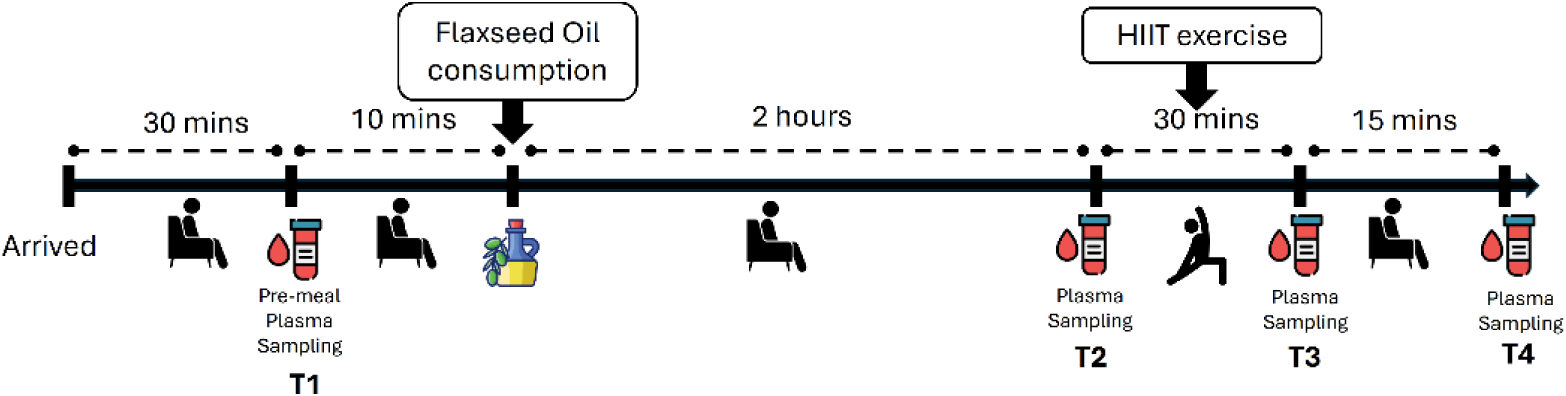
Blood was drawn four times: fasting before intake, two hours after intake, immediately after exercise and after 15 minutes of recovery. The team quantified oxidized phosphatidylcholines (oxPCs) and oxysterols by targeted LC-MS/MS and profiled the wider plasma phospholipidome by untargeted high-resolution LC-QTOF-MS.
The two lipid classes complement each other. oxPCs form when phospholipids in cell membranes and lipoproteins oxidize. Oxysterols such as 7β-hydroxycholesterol and 7-ketocholesterol are free-radical oxidation products of cholesterol. Together they provide a molecular readout of lipid peroxidation as it happens.
What the Data Show
The effect started before anyone exercised. Two hours after intake, two truncated oxPC species, KDdiA-PC and KOOA-PC, had fallen by 31.3% and 60.9% relative to baseline in the flaxseed oil arm.
Exercise then separated the two arms sharply. Without the oil, five of the seven quantified oxPC species rose significantly after HIIT, with SONPC and KDdiA-PC increasing by roughly 150 to 190%. With the oil, these increases did not occur, and many oxPC levels were below baseline.
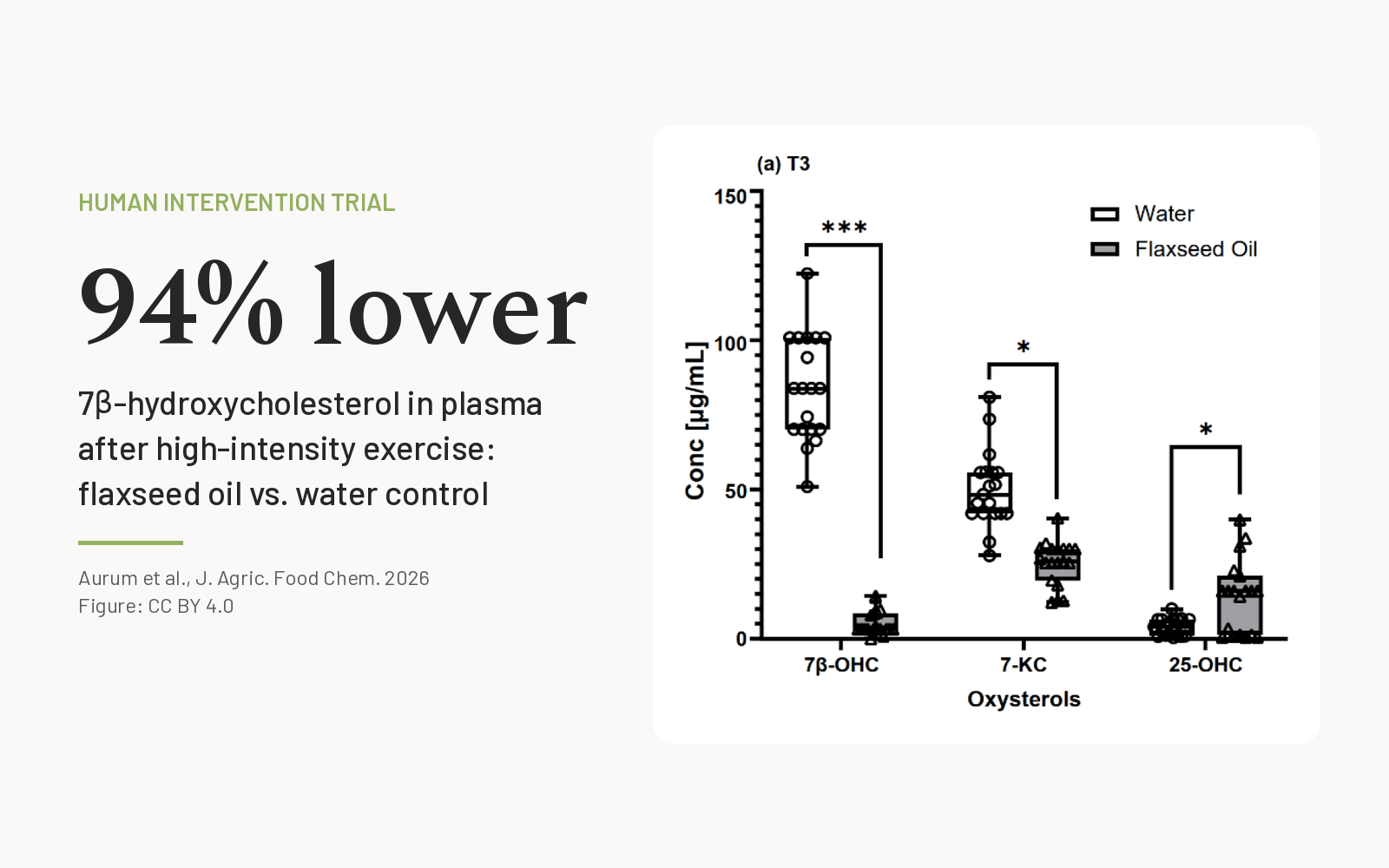
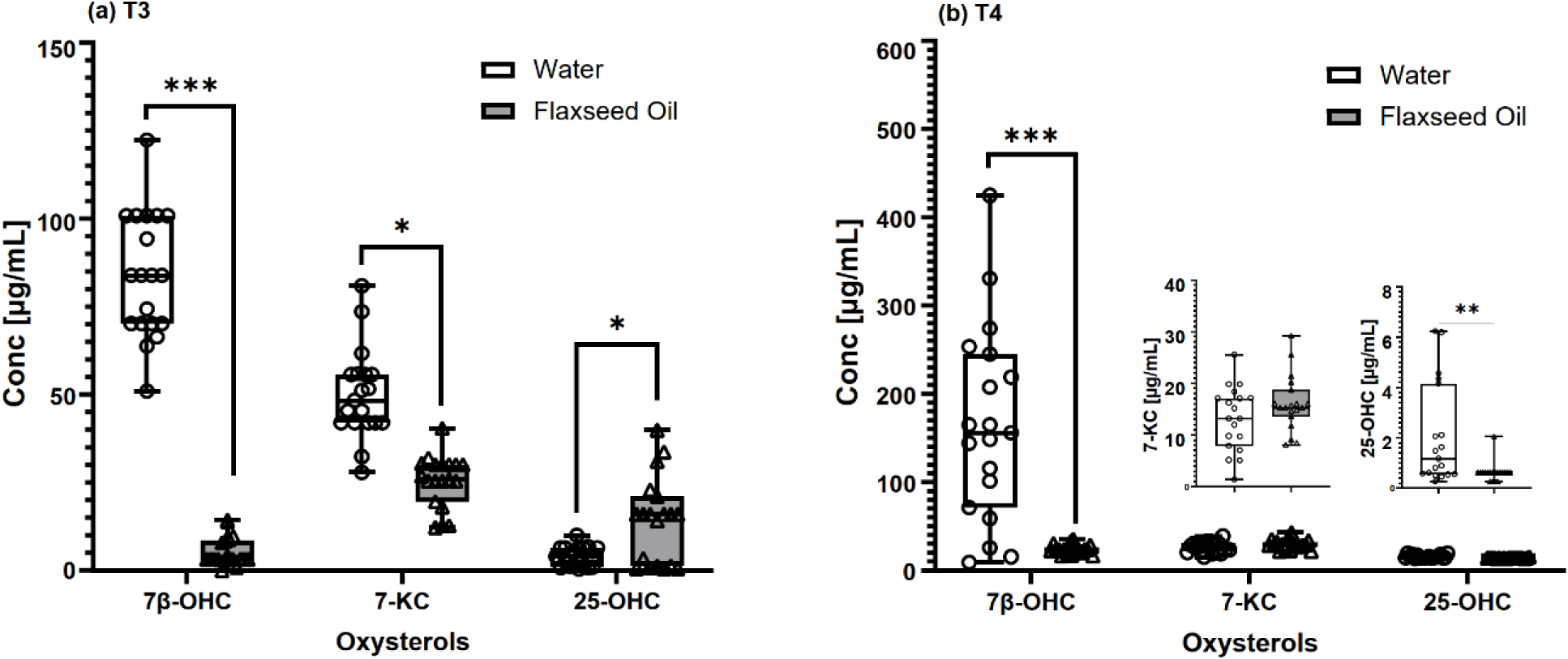
The oxysterol data were even clearer. Immediately after exercise, average plasma 7β-hydroxycholesterol was about 94% lower in the flaxseed oil arm than in the water arm, and 7-ketocholesterol was about half. After 15 minutes of recovery, 7β-hydroxycholesterol had risen further in the water arm while it stayed suppressed in the oil arm.
Multivariate models confirmed the picture. The plasma oxPC profiles of the two arms were already distinguishable two hours after intake and separated most clearly at peak oxidative stress. The untargeted analysis identified around 130 phospholipids; about two-thirds of the phosphatidylcholine species that differed significantly were higher in the flaxseed oil arm, consistent with less oxidative breakdown of intact membrane lipids. The authors conclude that the oil acts at the initiation phase of lipid oxidation rather than merely speeding up the clearance of oxidation products. [1]
What the Study Does Not Show
Good data deserve precise reading. This was an acute, single-dose trial in 19 young, healthy women with an observation window of a few hours. The control was water, not conventional flaxseed oil, so the design shows the effect of the polyphenol-enriched oil as a whole rather than isolating the contribution of the enrichment. Not every marker moved in the same direction: 25-hydroxycholesterol, which can also form enzymatically, was higher in the oil arm directly after exercise and lower after 15 minutes of recovery. Repeated dosing, dose-response and sex-specific effects are open questions the authors name themselves.
Plasma oxidation markers are research endpoints, not clinical outcomes. The results are not an authorized health claim under Regulation (EC) No 1924/2006, and any use in consumer-facing communication requires its own regulatory review. Prof. Pignitter's role as co-founder of Lipid Legends is declared in the publication. The research was funded by the Austrian Science Fund (FWF) and approved by the ethics committee of the University of Vienna.
Why This Matters for Oil Producers and Food Manufacturers
Oxidative stability has long been treated as a technical parameter: a number on a specification sheet that determines shelf life. When the antioxidant capacity that protects an oil in the bottle also shows up as a measurable difference in human plasma, stability stops being only a cost parameter and becomes a functional property.
For producers of premium and functional oils, that means differentiation you can document. For manufacturers of cold applications such as dressings, spreads, functional foods or supplements, it means an omega-3 oil with markedly higher oxidative stability. For brand owners and retailers, it means a product story backed by peer-reviewed data rather than adjectives. We made the broader case in The Future of Edible Oils: the value of an oil will increasingly be defined by cost per unit of functionality, not by cost per kilogram.
The Technology Behind the Oil
The optimized flaxseed oil in this trial was produced with Lipid Legends technology, developed from lipid research at the University of Vienna. We do not disclose the process here. What matters for partners is what it delivers: a cold-pressed oil with a multiple of the natural polyphenol content, markedly higher oxidative stability, and now human data on oxidative markers in plasma.
We see this as the direction edible oil production is heading: oils designed for stability and nutritional functionality from the seed onwards, not only for yield and price. Flaxseed oil was the most demanding proving ground. We are now applying the same technology to sunflower oil, rapeseed oil and coffee oil. Results for our optimized cooking oils are already available.
Work With Us
If you produce, refine or formulate with edible oils and want higher oxidative stability, longer shelf life or evidence-backed differentiation, we offer technology licensing and joint development projects, from lab trials with your raw material to scale-up.
Talk to Polina Novikova, our Business Development Manager, at polina.novikova@lipid-legends.com, or read more about our optimized flaxseed oil.
Reference
[1] Aurum, F. S., Brem, J., Strauss, M., Gassner, M., König, D., Pignitter, M., Oxidomics of Human Plasma Reveals Lower Oxidized Lipids After Acute Intake of Polyphenol-Enriched Flaxseed Oil: A Randomized Crossover Exercise Trial. J. Agric. Food Chem. 2026. DOI: 10.1021/acs.jafc.6c08737. Open access under CC BY 4.0.
Share it with your friends!


Lipid Magazine
Go to MagazineOptimized Flaxseed Oil Trial

Hexane: Solvent Debate for Oil Mills
.jpg)
Stable vegetable oils
Our commitment to the highest quality and safety is reflected in each of our products.
Safety
We offer healthier alternatives to conventional cold-pressed vegetable oils.
Learn More
Discover insider secrets, valuable knowledge, impressive stories and much more in our magazine.
to magazine
